
Serving as a standard identifier for the 2001 penny no mint mark, the absence of a letter under the date on a one-cent coin issued in 2001 remains the norm.
Historically, excluding the "P" mark for copper and zinc cents, this facility maintained the tradition with the exception of the 2017 issue.
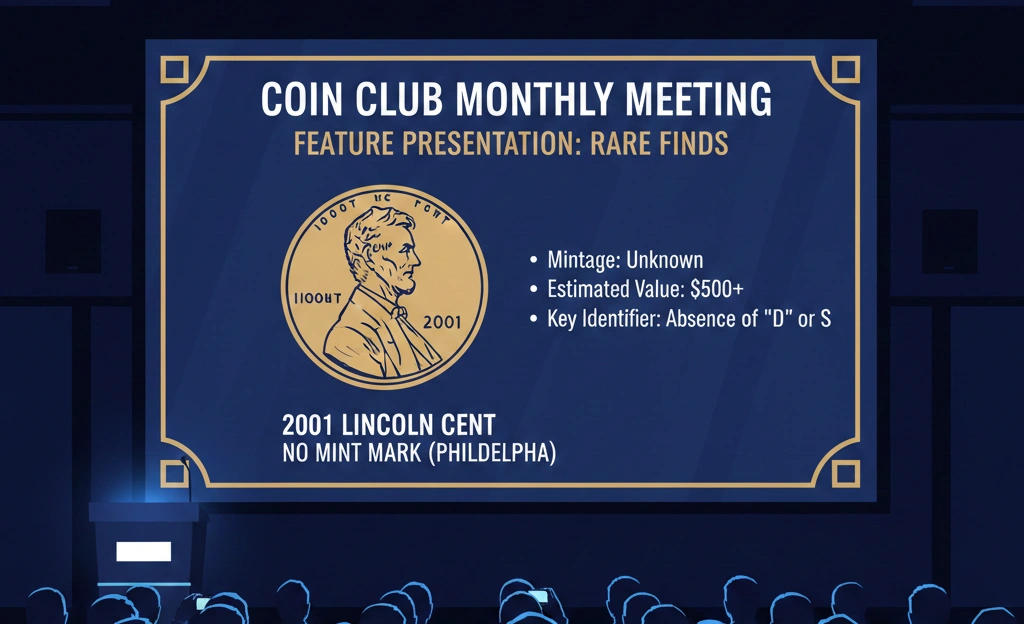
Production in 2001 relied on utilizing zinc alloy planchets possessing a thin electrolytic coating of pure copper.
Mass measurements for the item equal 2.5 grams with a diameter of 19.05 millimeters.
Thickness for the coin is fixed at 1.52 millimeters.
Possessing a plain edge without reeding is a structural feature of this denomination.
High-power automated presses ensured the output of thousands of units per minute during the manufacturing cycle.
Mintage and Population
Production figures for 2001 coins without a mint mark reached 4,959,600,000 specimens.
Accounting for approximately 48% of the total cent mintage in the US during the specified calendar period, this volume remains massive.
Finding specimens in MS68 condition and higher remains difficult for technical reasons despite the high mintage.
Condition | Quantity (Population) | 5-Year Price Growth (%) |
MS66 RD | > 5,000 | 2% |
MS67 RD | 1,245 | 4% |
MS68 RD | 162 | 12% |
MS69 RD | 4 | 25% |
Market Value and Auction Records
Directly depending on the preservation of the copper layer and the absence of zinc core degradation, the value of a 2001-P cent varies significantly.
Specimens removed from circulation are valued at face value or by metal weight.
Investment interest remains focused exclusively on coins in MS68 and MS69 grades.
MS69 RD Record Sale: Sold for $4,320 at a public auction in 2022, a coin in this condition represents the market peak.
MS68 RD Cost: Current market offers fluctuate between $180 and $350.
MS67 RD Category: Prices range from $15 to $30, demonstrating a stable supply.
Reducing the grade by one step decreases the asset's value by an average of 10 times.
Transitioning from the Red (RD) color category to Red-Brown (RB) devalues the coin by 80–90% relative to maximum market prices.
Zinc Corrosion and Plating Defects
Introduced in 1982, the technology for producing zinc-based coins possesses several operational disadvantages.
Copper plating having a thickness of only a few microns may contain pores allowing moisture and oxygen to reach the core.
Electrochemical reactions resulting in the formation of gas bubbles often deform the coin surface.
Classified as "plating blisters," this phenomenon acts as the primary reason for coin rejection during professional grading.
Presence of zinc corrosion under the copper layer makes obtaining an MS68 grade impossible.
Preserving coins in RD condition requires utilizing airtight capsules and maintaining indoor humidity below 35%.
Copper oxidation leads to the formation of patina, changing the color from bright red to brown.
Errors and Varieties
Characterized by several documented types of minting errors, the 2001-P cent offers several technical varieties.
Off-Center Strike
Displacement of the planchet relative to the die leads to the appearance of empty areas on the disk.
Specimens from 2001 with an offset of 50% or more are valued at $75–$150.
Retaining the 2001 date and the absence of a mint mark serves as an important price factor.
Wide AM Variety
Checking the reverse for the distance between the letters A and M in the word AMERICA is a standard for late 1990s coins.
Remaining a subject of technical discussion without mass confirmation, the existence of this variety for 2001 is debated.
Discovering a confirmed 2001-P Wide AM specimen potentially increases the coin's value to $500 and higher.
Die Clashes
Striking each other in the absence of a planchet, the dies leave mirrored design impressions.
Outlines of the Lincoln Memorial columns may be visible on the 2001-P obverse.
Such specimens sell at prices ranging from $5 to $20 depending on the intensity of the mark.
Grading Procedure
Assigning a professional grade to a coin relies on analyzing three main parameters.
Luster: The ability of the surface to reflect light in a radial "cartwheel" pattern
Strike: The degree of detail execution, such as Lincoln's hair and memorial lines
Eye Appeal: Absence of spots, scratches, and plating bubbles
Utilizing 10x magnification allows for the identification of microscopic contact injuries.
Falling into general bins upon completion, 2001 coins often possess field defects.
Reaching the MS69 level requires the surface to be practically devoid of contact signs.
Population Dynamics for 2014–2024
Statistics from grading companies show changes in the number of certified coins.
Increasing by 40% over a decade, the total number of 2001-P cents in MS67 grade has grown.
Growing by only 15%, the number of coins in MS68 grade indicates the difficulty of finding quality material.
Remaining stable, the MS69 population does not demonstrate an increase of more than one specimen every few years.
This stability provides capital protection for owners of top specimens.
Annual opening of 2001 bank rolls increases the supply of MS66 coins, lowering their market premium.
Yielding less than 0.001%, the percentage of MS68 coins emerging from modern bank stocks remains low.
Denver Issue
Possessing identical physical parameters, coins from Philadelphia (2001-P) and Denver (2001-D) show different rarity indicators.
Denver issued 5,374,990,000 cents in 2001, exceeding the Philadelphia mintage by 415 million.
Being significantly higher for Denver, the MS69 RD population makes the Philadelphia issue more valuable in the highest grade.
Average MS68 RD prices for Denver remain 30–40% lower than the same indicator for Philadelphia.
Evaluated as less stable compared to Denver, the technical state of dies in Philadelphia in 2001 remained problematic.
Numismatic Asset Storage Methodology
Maintaining the Red condition requires adherence to technical regulations.
Utilizing polyvinyl chloride albums is prohibited due to the risk of chemical reaction with copper.
Applying polyethylene terephthalate holders or rigid acrylic capsules is recommended.
Temperature conditions should be maintained in the range of 18–22 degrees Celsius.
Sharp temperature fluctuations cause micro-expansions of the zinc core, destroying the copper film.
Utilizing silica gel allows for absorbing excess moisture in a safe or deposit box.
2001-P MS69 RD (PCGS) — $4,320 in 2022
2001-P MS68 RD (PCGS) — $384 in 2023
2001-P MS67 RD (NGC) — $28 in 2024
2001-P Struck 15% Off-Center MS64 RD — $45 in 2023
2001-P Double Struck Second Strike 70% Off — $115 in 2022
Being a mass-produced product, the 2001 cent without a mint mark derives its value exclusively from microscopic details.
Serving as a standard designation of the minting location, the absence of a mint mark is not a sign of rarity.
Instability of the zinc base and a tendency toward hidden corrosion remain the main risk factors for an investor.
Professional certification serves as a mandatory condition for recognizing a coin as a trading asset.
Indicating the feasibility of acquiring coins in grades no lower than MS68, confirmed population statistics support long-term holding.